English
 Español

How to Choose a Plating Barrel for Bolts, Screws and Washers
A pointed screw can catch by its tip in a barrel opening even when its head is too wide to pass through. A thin washer presents a different problem. It can stay inside the barrel throughout the cycle and still come out with a bare patch where two faces stuck together.
When ordering an automatic barrel plating line, give the supplier the fasteners that are likely to cause trouble as well as the part you run most often. Ask the supplier to identify which parts the barrel can handle and the working load it used to calculate output for a normal shift.
Which Fasteners Belong in the Trial?
Send each part number in its own labeled lot. Include a drawing or a marked-up photo so the person inspecting the load knows which threads, faces or edges matter to your customer.
| Sample to send | What to look for | What to record |
|---|---|---|
| Smallest pointed screw | A tip wedges in a panel opening or at the door edge. | Where it caught and whether any pieces remained after discharge. |
| Longest bolt or stud | Parts bunch together as they turn, or exposed threads pick up knocks. | The load at which the parts tumbled freely and the finished thread inspection result. |
| Thinnest flat washer | Washers cling face to face during processing. | Whether pairs stayed together and the condition of the two faces that touched during plating. |
Include a normal production lot as a reference. If a particular part repeatedly fails the customer’s limits for surface marks or thread damage in bulk trials, review the rack and barrel plating options for that part before including it in the line’s quoted capacity.
Check the Barrel Panel, Door and Electrical Contacts
Ask for a drawing of the proposed barrel panel. For round holes, request the diameter. For slots, request the width and length. Also ask how much of the panel is open. The openings let solution move through the load, so making every hole smaller to retain one troublesome screw can introduce a second problem.
A sample panel is a quick way to see whether the screw tip can enter an opening. If it can, include that screw in a loaded trial with the proposed door fitted. Check the door joint and corners after unloading. One screw left behind can turn up in the next customer’s lot.
Give the supplier the plated area per part if you know it. Two loads of the same weight can present different surface areas and require different currents. Ask which cathode contacts will carry that current to the moving parts. Flexible contacts, commonly called danglers, extend into the load. If long parts catch around them, ask the supplier to trial an alternative contact arrangement. Record which arrangement was used for the plated samples you approve.
Use the Trial Load to Check Line Capacity
Have the quotation list the mechanical load rating and the working load for each fastener family separately. Weigh an actual batch and record the loose volume it occupies. A batch of long bolts can take up quite a different amount of barrel space from the same weight of compact nuts.
Consider a planning example with 480 kg to process in six net production hours. At 40 kg per load, the line needs 12 loads, or one launch every 30 minutes. If trials limit a particular part to 30 kg per load, the same shift needs 16 loads, or one launch every 22.5 minutes.
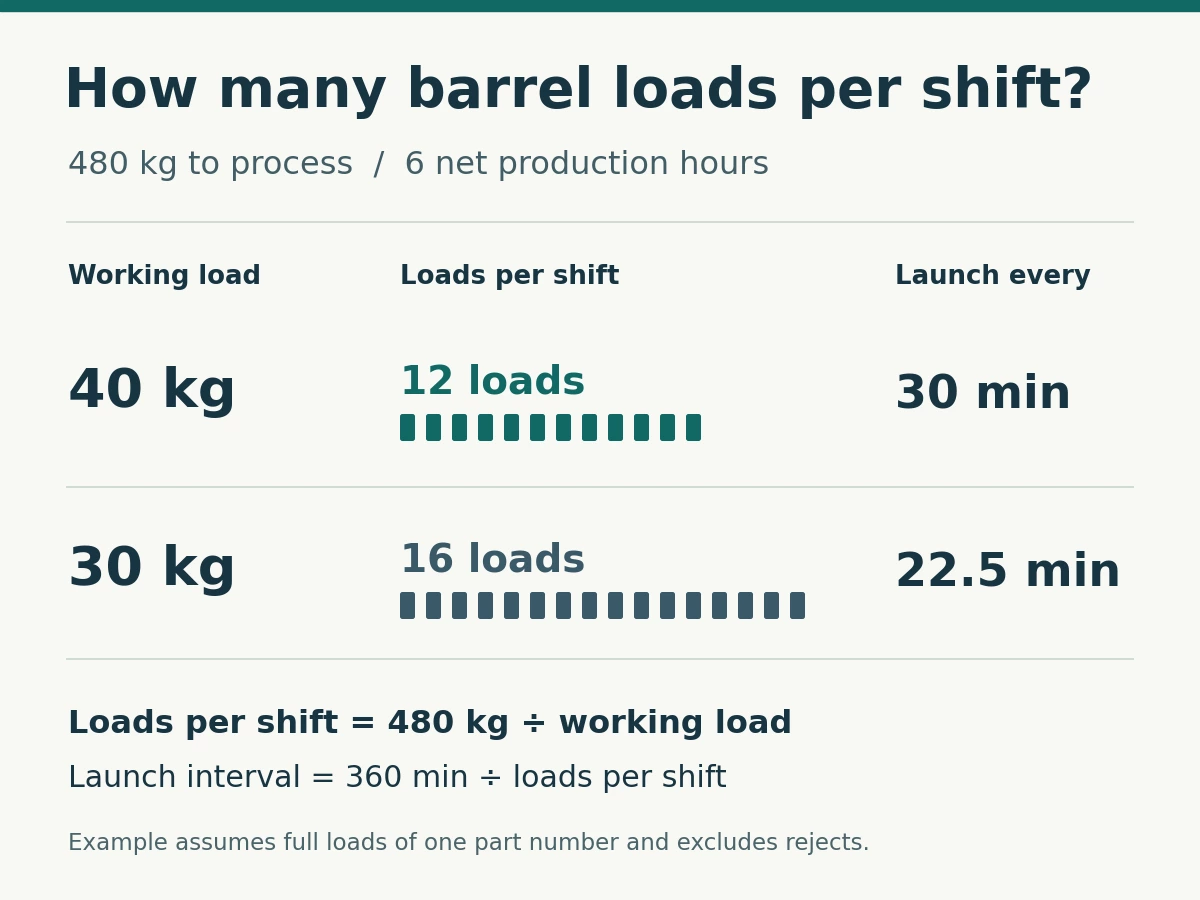 Noted: At the same shift target, reducing the working load from 40 to 30 kg adds four barrel loads.
Those intervals describe how often a new barrel enters the line. Several barrels can be in process at the same time. The example assumes full loads of one part number and excludes rejects. For your actual shift mix, use the electroplating line capacity calculation to check whether the tanks and transfer system can sustain the required interval.
What Should the Trial Report Show?
Agree on the acceptance checks before the trial. A handling trial shows what happens during rotation and discharge. A plated trial also lets your quality team check the finished part against the drawing. Ask for three things in the report.
- The load as tested. Record part number, batch weight, panel opening, contact type and whether the trial used the proposed production barrel or a smaller test barrel.
- The finished parts. Check coating thickness at the specified locations. For threaded parts, use the gauge and acceptance limits on the drawing. For washers, inspect both faces of any pair found together.
- The discharge result. Record damaged or retained parts, where they were found and the result of any repeat trial after a change.
What to Send for a Barrel Plating Line Quotation
For an automatic barrel plating line for bolts and nuts, send a short part list with dimensions, unit weight, base material, finish specification, normal lot size and required output per shift. Identify any lots that must stay separate and any part you already have trouble unloading or inspecting.
Email the drawings to plating@chinamakeco.com and tell us which part sets your daily production target. You can also use our project inquiry form or message us on WhatsApp to discuss the trial loads for your line.