English
 Español
Rack Plating vs. Barrel Plating: How to Choose the Right Electroplating Line
Choosing between rack plating and barrel plating is not simply a question of part size or production volume. The loading method changes how parts are held, how electrical current reaches them, how they move through the solution, how much solution they carry into the rinse stages, and how operators load and unload the line.
A small part is not automatically suitable for barrel plating. It may be too delicate, may nest with adjacent parts, or may have a visible surface that cannot accept contact damage. A large production order does not automatically require a barrel line either. If every part must remain separated and oriented, an automatic rack line may still be the correct production method.
The decision should begin with representative parts, the approved coating specification, appearance requirements, production targets and acceptable handling marks. This guide explains the main differences and the questions buyers should resolve before selecting an electroplating line.
What Is Rack Plating?
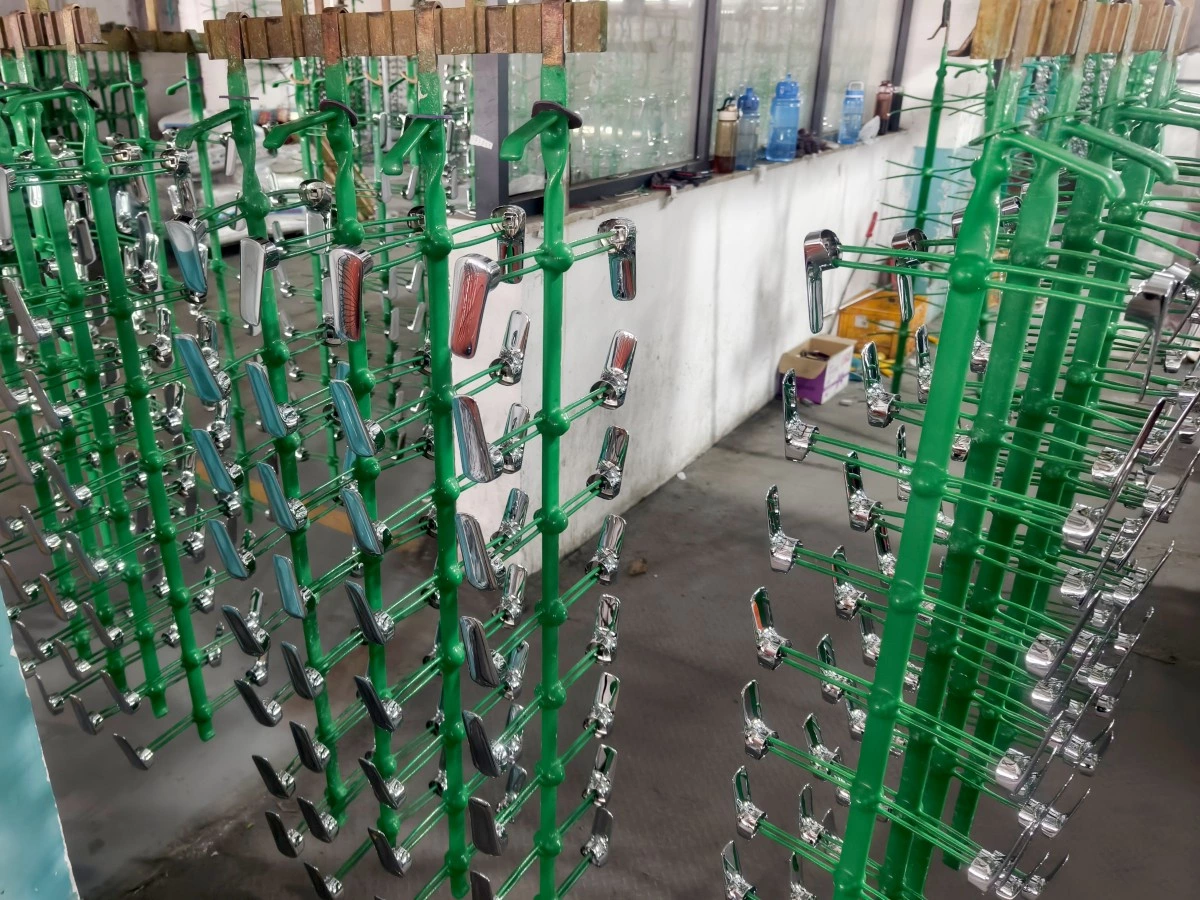
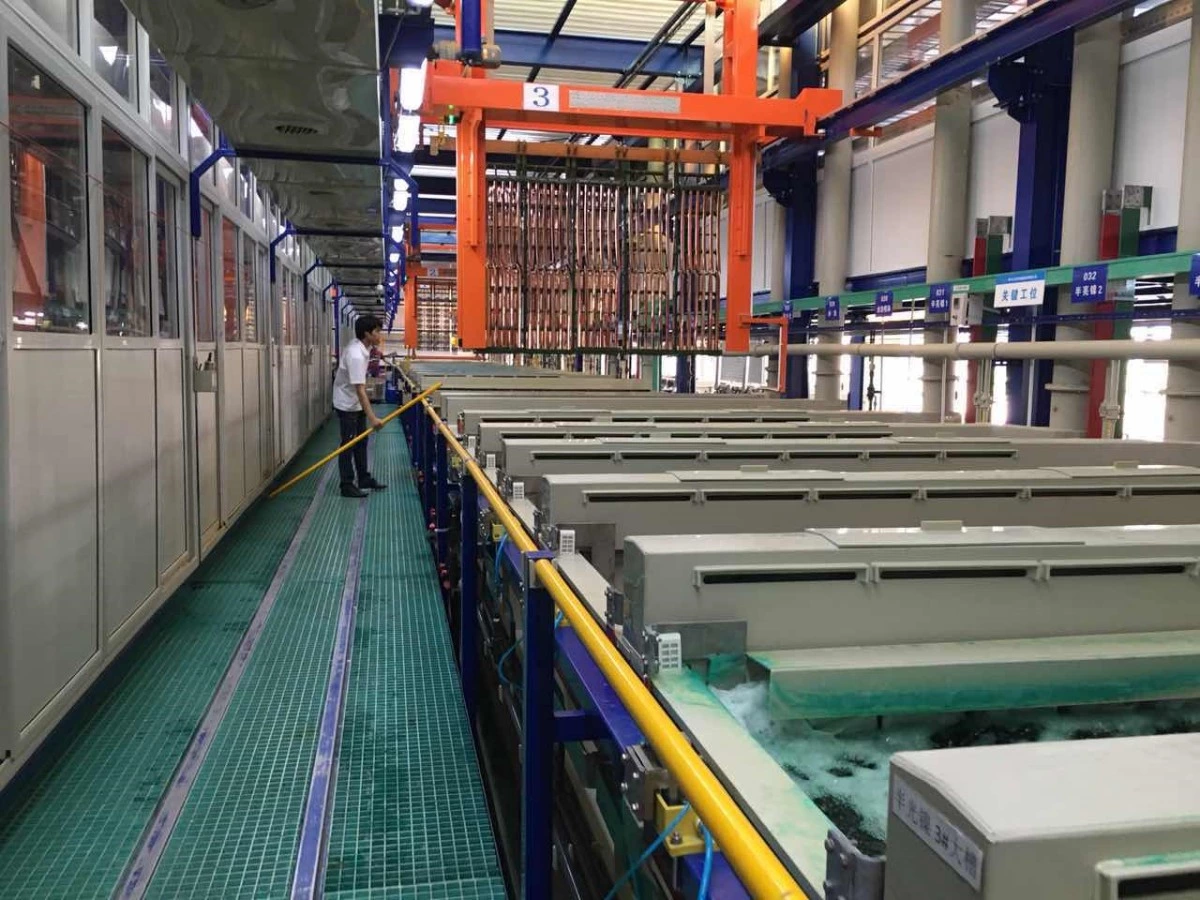
In rack plating, individual workpieces are secured to a conductive fixture. The rack holds each part in a defined position and provides an electrical path between the cathode bar and the workpiece. The loaded rack is then transferred through the required pretreatment, plating, rinsing and post-treatment stages.
Because the workpieces remain separated and keep a controlled orientation relative to the rack, this method is commonly evaluated for:
-
Large or relatively heavy components
-
Parts that could scratch, bend or deform if they collided with one another
-
Decorative surfaces that must be protected from part-to-part contact
-
Components that require a controlled hanging angle for drainage or gas release
-
Parts with a defined non-critical area for the electrical contact point
-
Product families that can be loaded repeatably on dedicated fixtures
A rack electroplating line can be manual, semi-automatic or fully automatic. Automation controls rack transfer and process timing, but it does not remove the need for correct rack design. Contact position, contact pressure, part spacing, rack shielding, drainage and current-carrying capacity all affect the result.
Rack plating also has practical limitations. Each part must be loaded and unloaded, racks require cleaning and maintenance, and the fixture contact normally leaves an unplated or less-visible mark. Custom racks may be needed for different product families, so tooling cost and changeover time belong in the project calculation.
What Is Barrel Plating?
In barrel plating, multiple small parts are loaded together into a perforated barrel. The barrel is immersed in the process solution and rotates so that the parts move through the load. Electrical current is supplied through barrel contacts or flexible danglers, while the moving parts repeatedly make and break contact within the load.
This method is commonly considered for high quantities of small, mechanically robust parts, including certain fasteners, nuts, washers, pins and small stampings. Bulk loading can reduce the individual handling required for each piece, but suitability depends on more than whether the parts fit inside the barrel.
A part may be unsuitable for barrel plating if it can:
-
Nest tightly against another part and block solution or current
-
Tangle with similar parts during rotation
-
Lodge in the barrel perforations
-
Bend, chip, dent or scratch during part-to-part contact
-
Trap solution in holes, folds or recesses
-
Damage threads or other critical features during tumbling
-
Create a load that cannot move and exchange solution freely
A barrel electroplating line must therefore be designed around the actual part geometry, total plated surface area, load weight, barrel size, perforation, rotation conditions, electrical contact method and process sequence. The maximum mechanical weight of a barrel is not automatically the correct production load.
Rack Plating vs. Barrel Plating: Main Differences
| Evaluation point | Rack plating | Barrel plating |
|---|---|---|
| Part loading | Parts are fixed individually on a conductive rack | Parts are loaded together as a bulk batch |
| Part movement | Each part keeps a controlled orientation relative to the rack | Parts tumble and change position inside the rotating barrel |
| Typical part profile | Large, delicate, appearance-sensitive or orientation-dependent parts | Small, robust parts that can move without nesting, tangling or damage |
| Part separation | Parts can be spaced to avoid contact with one another | Part-to-part contact is inherent to the process |
| Electrical contact | Defined rack contacts connect individual parts | Current reaches the moving load through barrel contacts or danglers and changing contact between parts |
| Contact marks | A fixed rack contact mark must be placed in an acceptable area | No single rack point, but temporary contact interruption and handling marks must be evaluated |
| Loading labor | Usually higher because parts are attached and removed individually | Usually lower per piece because parts are loaded and unloaded in bulk |
| Tooling | Product-specific racks may be required | Barrel type, size, perforation and contacts must suit the parts |
| Main mechanical risks | Weak contact, poor orientation, rack shadowing, trapped solution or collision | Nesting, tangling, lodging, scratching, deformation or restricted load movement |
| Capacity basis | Parts and plated surface area per rack, rack interval and process positions | Parts or weight per barrel, total surface area, load behavior, barrel interval and process positions |
This table is a screening tool, not a final equipment specification. Neither method guarantees coating uniformity by itself. Current distribution, anode arrangement, part geometry, solution movement, bath control, loading density and process time still have to be engineered and validated.
1. Start with Part Size, Weight and Mechanical Strength
The first question is whether the part can be held, moved and processed safely by the selected method.
Large or heavy parts often require racks because a barrel cannot provide the necessary space or controlled handling. Thin, polished or easily damaged parts may also require racks even when they are physically small. The purpose is to prevent uncontrolled contact and to maintain the orientation required by the process.
Barrel plating becomes practical when many small parts can move together without unacceptable damage. However, a trial load should be assessed at realistic quantity. A few samples may tumble freely while a full production load compacts, nests or moves poorly.
The line supplier should receive the minimum and maximum part dimensions, unit weight, photographs or drawings, base material and representative samples. For rack plating, the supplier also needs the expected parts per rack and total loaded-rack weight. For barrel plating, the proposed load weight and fill condition must be checked against part movement and coating performance, not only against hoist capacity.
2. Examine Geometry Before Choosing Bulk Loading
Geometry is often the deciding factor for small parts. Flat components can lie against one another. Hooks, springs and open shapes can interlock. Long thin parts can bridge across the barrel, while very small pieces can enter or block perforations. Blind holes and folded sections may retain one solution and carry it into the next stage.
These risks affect more than appearance. They can reduce cleaning, activation, plating and rinsing on shielded surfaces. They can also cause mixed parts to remain attached after unloading or create handling problems in dryers and post-treatment equipment.
For rack plating, geometry creates a different set of questions. The part must have a secure contact location, enough clearance from adjacent workpieces and a hanging angle that allows solution and gas to leave recessed areas. The rack must also keep the load clear of anodes, tank walls, heaters, pipes, covers and exhaust hoods throughout lifting and transfer.
If geometry is uncertain, conduct a loading and handling trial before the tank layout is finalized. Drawings are important, but they may not reveal how real parts behave together in a moving barrel or on a fully loaded rack.
3. Define Appearance, Contact and Handling Limits
For decorative work, “good surface quality” is too vague to select equipment. The buyer should identify Class A or customer-visible surfaces, permitted contact areas, acceptable rack marks, scratch limits, color requirements and coating-thickness acceptance points.
Rack plating prevents parts from striking one another, but the rack contact must touch the workpiece. That contact should be positioned on a non-critical area whenever the product design permits. Contact condition also needs regular control: weak, dirty or overheated contacts can produce unstable current delivery.
Barrel plating avoids a permanent fixture point on every part, but the components repeatedly touch during processing. A functional zinc coating on robust fasteners may accept this handling, while a mirror-finished decorative component may not. The decision must follow the actual inspection standard rather than a general assumption that one method always gives a “better” finish.
4. Calculate Electrical Demand from Surface Area
Piece count and total weight do not show the electrical demand of a load. Rectifier capacity begins with the total active plated surface area and the approved current-density range for the process. The complete current path, including busbars, rack or barrel contacts and workpiece contact behavior, must also be considered.
In a rack line, the location and orientation of each part relative to the anodes can be controlled. However, crowded loading may cause shielding or uneven current distribution. A well-designed electroplating rack balances loading density with contact, spacing, drainage and coating requirements.
In a barrel line, electrical contact changes as the load moves. Excessive loading can restrict movement and reduce reliable contact within the batch. For this reason, barrel capacity should not be specified only in kilograms. Total surface area, part shape, contact behavior and the validated load condition are also required.
5. Compare Real Production Capacity, Not Parts per Batch
Barrel plating can place many small parts in one load, while rack plating holds a defined number of separated parts. That difference does not prove which complete line will achieve the higher acceptable output.
Production capacity depends on:
-
Acceptable parts per rack or barrel
-
First-pass quality yield
-
Process residence time at every stage
-
Number of parallel tank positions
-
Rack or barrel dispatch interval
-
Hoist travel, lifting, lowering and drain time
-
Loading and unloading time
-
Drying, baking or other post-treatment capacity
-
Product changes, maintenance and planned downtime
The correct comparison is acceptable parts per shift under an agreed product mix and operating schedule. Our guide to electroplating line capacity calculation explains how to convert the required output into loads, dispatch intervals, tank positions and transfer demand.
6. Evaluate Rinsing, Drag-Out and Post-Treatment
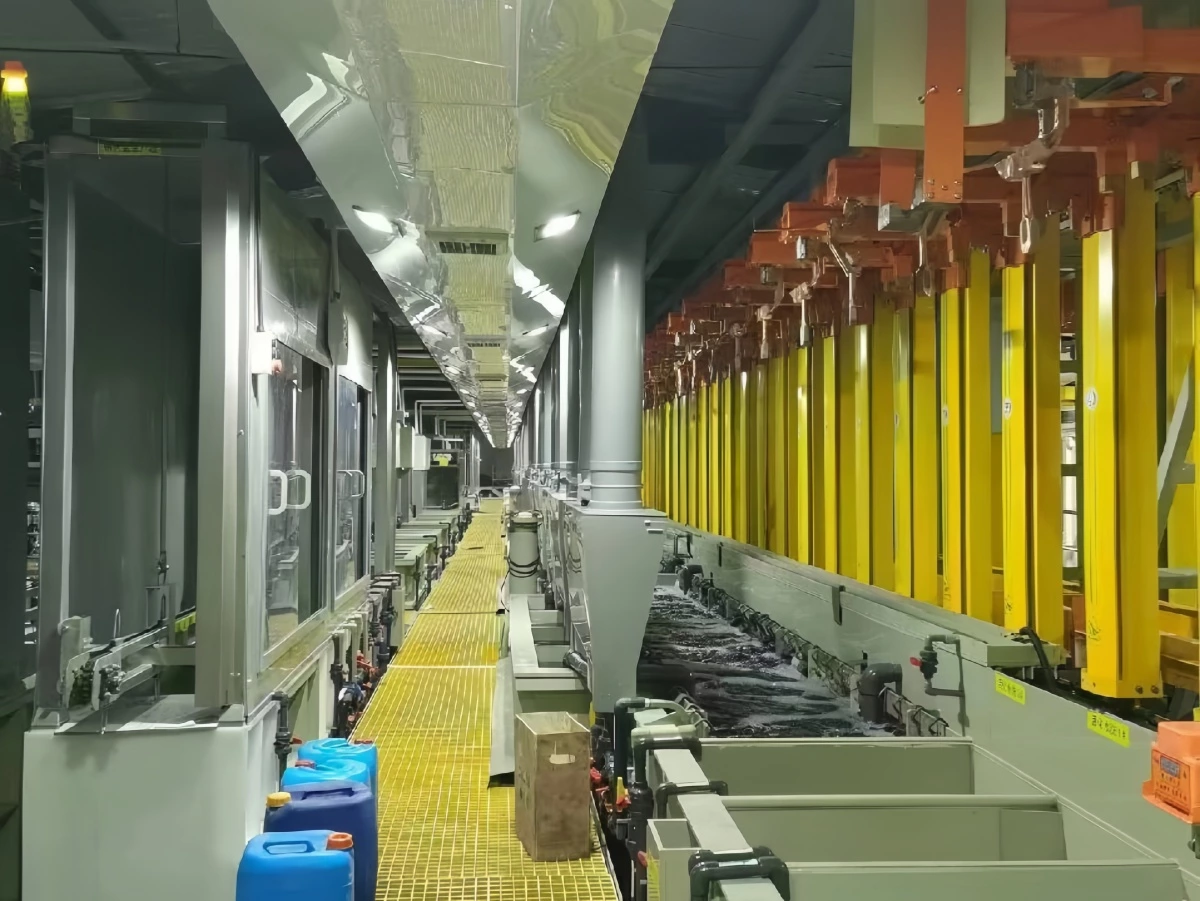
The loading method changes the way process solution leaves a tank. Rack orientation, part pockets and drain time influence carryover from a rack load. Barrel perforation, rotation above the tank, load shape and retained solution influence drainage from a barrel.
The rinse system must be sized for the actual contamination carried forward and the required cleanliness before the next step. Simply copying the same rinse flow from another line can increase water consumption or leave insufficient control. Review the electroplating rinse system design guide when defining rinse stages, counterflow arrangement, water-quality requirements and wastewater interfaces.
Post-treatment also matters to the loading decision. Passivation, sealing, drying, baking and cooling equipment must accept the same rack or barrel load rate as the plating line. If high-strength steel parts require an approved embrittlement-control route, the handling method does not remove that requirement; transfer and baking responsibilities must be defined in the process plan.
7. Compare Total Operating Cost
The lowest equipment price is not necessarily the lowest production cost. A practical comparison should include:
-
Rack design, manufacture, stripping, repair and replacement
-
Labor for loading, unloading and inspection
-
Barrel maintenance, contacts and perforation suitability
-
Loading and unloading equipment for bulk parts
-
Rejects caused by marks, deformation, nesting or poor contact
-
Chemical loss through drag-out
-
Rinse-water and wastewater-treatment demand
-
Changeover and cleaning time
-
Production tracking and lot separation
-
Maintenance access and spare equipment
Barrel plating often reduces handling labor per small part, but this benefit only remains useful if the parts can be processed without unacceptable damage or quality loss. Rack plating may require more fixtures and loading work, but it can be more economical for parts whose value or finish requirement makes bulk contact too risky.
When a Factory Needs Both Methods
Some factories process a product mix that cannot be covered by one loading method. For example, the same facility may rack-plate visible faucet bodies or handles and barrel-plate compatible screws, nuts or small internal hardware.
This does not mean the two product groups can automatically use one common sequence of tanks. The substrates, coating systems, pretreatment, current requirements, contamination controls, post-treatment and production volumes must be reviewed separately. Depending on the project, the appropriate solution may be separate lines, selected shared support equipment, or a customized layout with clearly defined routes and operating limits.
For zinc and zinc-nickel projects, the loading method should be confirmed together with coating thickness, passivation, sealer or topcoat, corrosion-performance requirement and any embrittlement-control requirement. See the automatic zinc and zinc-nickel electroplating line guide for the information buyers should specify.
A Practical Selection Checklist
Rack plating is normally the stronger candidate when:
-
The parts are too large or heavy for the proposed barrel
-
Surfaces cannot accept part-to-part contact
-
Parts must remain separated or held at a defined angle
-
A controlled electrical contact can be placed in an acceptable area
-
Drainage, gas release or anode relationship requires repeatable orientation
-
The product value justifies individual handling and dedicated tooling
Barrel plating is normally the stronger candidate when:
-
The parts are small, robust and suitable for bulk movement
-
They do not nest, tangle, lodge in perforations or damage one another
-
The functional and cosmetic requirements allow the expected handling contact
-
A representative production load maintains movement, electrical contact and solution exchange
-
Bulk loading and unloading provide a real labor or output advantage
If several points remain uncertain, do not choose the line from a catalog description. Test representative parts and document the result before confirming barrel dimensions, rack layout, tank size, rectifier capacity or production output.
Information to Send with an RFQ
To compare a rack and barrel electroplating line on the same basis, provide:
-
Part drawings and clear photographs
-
Base material and incoming surface condition
-
Minimum and maximum dimensions and unit weight
-
Estimated plated surface area per part
-
Critical surfaces, permitted contact areas and handling-mark limits
-
Coating system, thickness and applicable acceptance standard
-
Approved pretreatment, plating, rinse and post-treatment sequence
-
Required output by hour, shift, day or year for each part family
-
Available rack-loading data or proposed barrel load weight
-
Representative physical samples for loading trials where possible
-
Workshop layout, ceiling height and material-flow restrictions
-
Available power, water, heating, cooling, exhaust and wastewater systems
-
Required automation, production records and lot-traceability functions
-
Expected future products or capacity changes
If some items are still unknown, mark them as open points. A quotation built on visible assumptions is more useful than one built on unverified standard values.
Conclusion
The central difference between rack plating and barrel plating is how the workpieces are held, moved and electrically connected. Rack plating separates and orients individual parts. Barrel plating processes many compatible parts as a moving bulk load.
The correct choice depends on the actual part geometry, strength, visible surfaces, contact limits, coating specification, production target and total operating method. Small parts can still require racks, and high production volume can still justify an automatic rack line. Neither method should be selected from part size or price alone.
If you are planning a new electroplating project, contact AutoPlatingTec with your part drawings or samples, coating requirements, production target and workshop information. Our engineering team can review the loading method and line configuration as one complete system.
Frequently Asked Questions
Is rack plating better than barrel plating?
Neither method is universally better. Rack plating is normally evaluated for large, delicate, appearance-sensitive or orientation-dependent parts. Barrel plating is normally evaluated for high quantities of small, robust parts that can move together without nesting, tangling or unacceptable damage.
Can small parts be rack plated?
Yes. Small parts may require rack plating when they are delicate, have critical visible surfaces, cannot tumble freely, need controlled orientation or require a defined electrical contact. Production volume alone does not determine the loading method.
Can decorative parts be barrel plated?
Only when the approved appearance standard allows the handling contact and trials show that the parts do not scratch, dent, nest or lose coating quality. Parts with highly visible or polished surfaces are often stronger candidates for rack plating, but the decision should be based on representative samples and acceptance criteria.
Does barrel plating always have higher capacity?
No. A barrel can contain many small parts, but acceptable line output also depends on load behavior, total plated surface area, process time, electrical contact, tank positions, transfer cycle, unloading and quality yield. Capacity should be calculated as acceptable parts per shift under defined operating conditions.
Which method gives more uniform coating thickness?
Neither loading method guarantees uniform thickness by itself. The result depends on part geometry, loading density, current distribution, anode arrangement, electrical contact, solution movement, bath control and process time. These factors must be evaluated for the real load.
Can one automatic electroplating line process both racks and barrels?
It may be technically possible in a customized project, but it should not be assumed. Rack and barrel loads have different handling, electrical, drainage, timing and control requirements. The process chemistry, production schedule, transfer equipment and tank interfaces must be reviewed before a shared system is proposed.